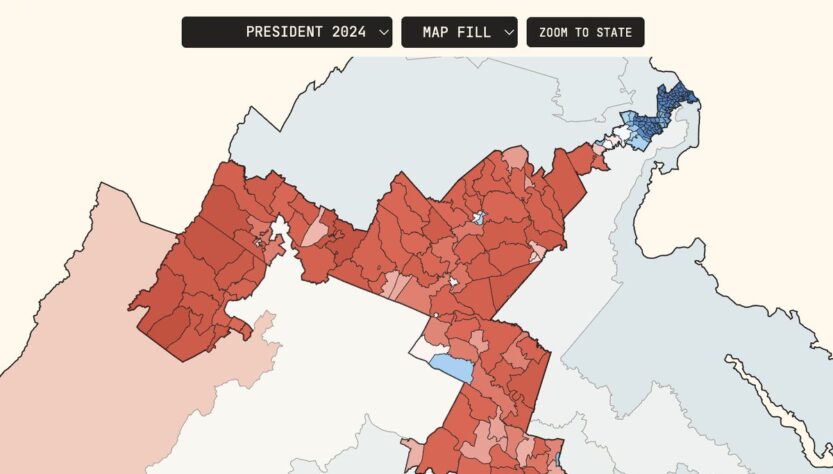
In a stunning assault on fair elections, Virginia voters on April 21, 2026, narrowly approved a constitutional amendment that hands politicians the power to redraw congressional districts mid-decade. This move doesn’t just tweak maps—it obliterates one of the most equitable redistricting systems in America, all while courts warned that the entire process was legally flawed. What Virginians got was not “restored fairness,” but a brazen partisan power grab dressed up in ballot language designed to confuse.
Virginia Had Just Achieved One of the Fairest Maps in the Country
Only a few years ago, Virginians took a historic stand against gerrymandering. In 2020, voters overwhelmingly approved a constitutional amendment creating a bipartisan redistricting commission to draw maps after the census. The result? Congressional districts for 2022 through 2030 that earned an “A” grade from the Princeton Gerrymandering Project—the fairest in the nation. The maps reflected the state’s actual partisan split with near-perfect precision, splitting the difference between Republican and Democratic vote shares by just 0.6 percentage points. No packing, no cracking, no safe seats engineered for one party’s dominance. It was a national model of how democracy should work when politicians are kept out of the map-drawing room.
That legacy of fairness lasted barely one election cycle.
The Stealth Power Grab: Democrats Bypass the Rules They Once Championed
With control of the General Assembly and governorship, Democrats rammed through a special-session constitutional amendment and pre-packaged enabling legislation (HB 29) containing a new congressional map. That map doesn’t even pretend at neutrality—it carves up the state to deliver Democrats as many as 10 of 11 seats, flipping up to four Republican-held districts. The pretext? Other states were redrawing maps, so Virginia needed to “respond.” The real goal? Locking in partisan advantage for the 2026, 2028, and 2030 elections before the next census.
welcome to the new rural subjects of the Arlingtonian Protectorate
— Cameron 🇺🇸 🗽🦅 (@CameronCorduroy) April 21, 2026
all voters will be required to provide at least two sets of pronouns to vote in upcoming midterms https://t.co/bTg92pf7RL pic.twitter.com/WqXAmzNynJ
This wasn’t normal redistricting. It was a mid-decade rewrite explicitly designed to entrench one party’s power—the very definition of gerrymandering that Virginians had voted to end.
Misleading Ballot Language That Masked the True Intent
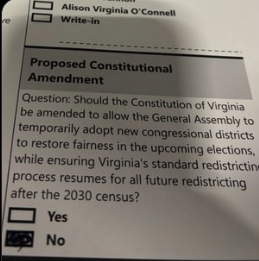
The referendum question put before voters was a masterpiece of misdirection: “Should the Constitution of Virginia be amended to allow the General Assembly to temporarily adopt new congressional districts to restore fairness in the upcoming elections, while ensuring Virginia’s standard redistricting process resumes for all future redistricting after the 2030 census?”
“Restore fairness”? The current maps were already the fairest in America. The loaded phrasing implied the existing system was broken and that politicians were riding to the rescue. Critics rightly called it confusing and deceptive, hiding the fact that the amendment would let lawmakers scrap the independent commission’s work and impose a lopsided map for three full election cycles. A straight-up question—“Should politicians be allowed to override the bipartisan commission and draw their own gerrymandered districts?”—would have produced a very different result.
Court Battles Ignored: The Vote Proceeded with Legality in Doubt
Republicans, the RNC, NRCC, GOP lawmakers, and even members of the bipartisan commission fought back in court, filing multiple lawsuits in Tazewell County Circuit Court.
In the first case (McDougle v. Nardo / Scott v. McDougle), challengers argued the amendment was illegally passed during a special session called for an unrelated budget issue. Tazewell Circuit Judge Hurley agreed, voiding the legislative vote in January 2026 and issuing an injunction. Democrats appealed.
A second lawsuit, brought by the RNC, NRCC, and Republican congressmen Morgan Griffith and Ben Cline, attacked the misleading ballot language itself. Judge Hurley again sided with plaintiffs in February, issuing a sweeping injunction halting all referendum preparations.
Twice the Virginia Supreme Court stepped in—not to resolve the merits, but to stay the lower court’s blocks. In February and again on March 4, 2026, the high court allowed early voting and the April 21 referendum to proceed, explicitly stating it would decide the underlying legality after the vote. The message was clear: let the people speak first, then we’ll decide if it counted.
That decision let the gerrymandering referendum go forward with a legal cloud hanging over it—the exact scenario you recalled. Oral arguments on the full cases are now imminent, with a final ruling expected in the coming weeks.
The Narrow Passage and the Impending Reckoning
The amendment passed by the slimmest of margins—roughly 51.5% to 48.5%. A majority of Virginians who voted said yes to politicians drawing their own maps. But that “yes” came under false pretenses and despite two lower-court rulings that the process was invalid.
Now the Virginia Supreme Court faces its moment of truth. (Cuccinelli: This is going to move FAST – not the usual “court speed”. Look for another Tazewell ruling as early as this week, and briefing in the Va. Supreme Court this week. Tazewell refers to a pair of decisions issued in early 2026 by Tazewell County Circuit Court Judge Jack C. Hurley Jr. that temporarily blocked Virginia’s controversial mid-decade congressional redistricting constitutional amendment referendum.)
With the vote complete, the justices must confront whether the amendment was lawfully proposed, whether the ballot language misled voters, and whether the whole scheme violates the spirit (and perhaps letter) of the 2020 reforms Virginians approved. Legal experts note the court has signaled “grave concern” over the process. A ruling striking down the amendment remains possible—and would restore the fair maps Virginians actually chose.
The "yes" vote has won Va's redistricting referendum — but the legal fight is just beginning. Four Va Constitutional challenges are now teed up:
— Ken Cuccinelli II (@KenCuccinelli) April 22, 2026
THREE challenges to the amendment process itself:
1️⃣ First passage was invalid. The amendment was taken up during a special session…
This Is Bigger Than Virginia
What happened in Virginia is a warning for the entire country. When one party uses procedural tricks, misleading language, and court delays to override independent redistricting reforms, democracy itself is gerrymandered. Virginians deserve better than maps drawn in back rooms to guarantee lopsided majorities. They deserve the fair system they voted for in 2020—the one that briefly made Virginia a beacon of electoral integrity.
The fight isn’t over. The courts still have the last word. But the damage to public trust is already done. Virginians should demand accountability: from the politicians who engineered this heist, from the ballot crafters who obscured the truth, and from a Supreme Court now tasked with cleaning up the mess. Fair maps aren’t optional—they are the foundation of representative government. Anything less is simply rigged.